Pokemon card market: November 2026
Is the Pokemon card market heating up or cooling down? Every week we track every card worth $20 or more and boil it down to one number.
Pokemon cards are cooling: the typical card worth $20 or more is down 3.2% over the last four weeks.
- Four weeks
- -3.2%
- Twelve weeks
- -
- Index
- 96.8
- Cards tracked
- 103
The Pokemon card market index
100 = the week of 12 October 2026. Weekly, chain-linked.
Biggest movers over four weeks
Climbing


Falling
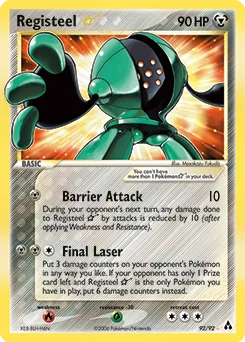 Registeel ★-43.7%
$5,152.00 to $2,902.70
 Lugia-38.4%
$279.99 to $172.50
 Mew ex-34.6%
$119.99 to $78.49
 Mewtwo ex-34.5%
$54.97 to $36.00
 Greninja ex-34.3%
$28.99 to $19.06
 Psyduck-33.9%
$74.99 to $49.54
How did your cards do?
Add the Pokemon cards you own and Premium shows how each one moved this month, and tells you when one moves 15% or more.
New and upcoming sets
New releases pull money towards their chase cards, so they are the first thing to check when the market turns.
- Delta Reign - released 6 November 2026
- 30th Celebration - released 16 September 2026
- 30th Celebration: Classic Collection - released 16 September 2026
What moves Pokemon card prices
New sets
A new expansion pulls money towards its chase cards for the first few weeks, and older singles often soften while it does. Prices for the new set itself usually peak in pre-release week and settle as boxes are opened.
Reprints
When a popular card or artwork is reprinted, the older printing usually dips first and recovers only if collectors still prefer the original.
Hype cycles
Japanese releases, influencer openings and anniversary products bring waves of new buyers. Those waves lift prices fast and fade almost as quickly, which is when dealers say the market has cooled.
Seasonality
Demand rises into the Christmas gifting season and dips in January, and summer tends to be quieter for singles than for sealed product.
How the index works
Each week we compare every card worth $20 or more with its own price the week before, and take the middle move across all of them. Chaining those weekly moves gives the index. A few spikes cannot drag it around, and new releases joining the list do not inflate it. A market is heating when the index is up 3% or more over four weeks, cooling when it is down 3% or more, and steady in between.
US market prices for ungraded cards. Prices change fast; treat this as a guide, not financial advice.
Common questions
- Is the Pokemon card market going down?
- Pokemon cards are cooling: the typical card worth $20 or more is down 3.2% over the last four weeks. Figures as of the week of 9 November 2026.
- How do you measure the Pokemon card market?
- We follow every card worth $20 or more and compare each one only with its own price the week before, then take the middle move across all of them. That stops a handful of spikes, or new releases joining the list, from distorting the picture.
- What do heating, steady and cooling mean?
- Heating means the typical card is up 3% or more over four weeks, cooling means down 3% or more, and steady is anything in between. The index moves less than single cards do, so a 3% move is a real shift.
- Where do the prices come from?
- They are US market prices for ungraded cards, based on recent sales, refreshed every week.
Every card market →|Pokemon TCG hub →|Hot Pokemon cards →|Upcoming release dates →